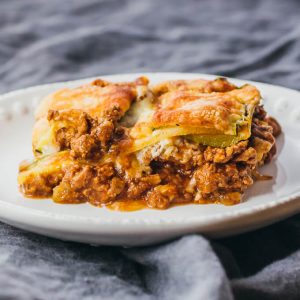
Zucchini Lasagna
4.85 from 121 ratings- Prep
- 20 mins
- Cook
- 1 hr 5 mins
- Cool
- 15 mins
- Total
- 1 hr 40 mins
- Makes
- 4 servings
Ingredients
Instructions
Brown Beef: Add ground beef to high-sided pan (Note 8) over medium-high heat. Crumbling beef with stiff utensil, cook until browned and released water has evaporated, 7 to 8 minutes. Optionally, drain off grease in pan, especially if using less than 90% lean beef.
Make Tomato Sauce: Add onions to pan with ground beef over medium-high heat. Cook until onions are softened and translucent, stirring occasionally, a few minutes. Reduce to medium heat, and stir in tomato sauce. Simmer until sauce is thick and clings to meat and onions (important for liquid control; Note 9), stirring frequently, about 10 minutes. Stir in oregano, salt, and cayenne until well-mixed, about 1 minute. Turn off heat.
Prep Oven & Cut Zucchini: Position oven rack in lower half of oven, and preheat to 375 F. For each zucchini, slice off and discard both ends. Stand zucchini vertically on a stable flat end, and carefully slice into 1/8 to 1/4 inch thick strips along the length (Note 10).
Assemble Lasagna: Arrange one-third of zucchini slices along bottom of 8x8 inch baking dish, slightly overlapping each other. Evenly spread half of meat sauce over zucchini slices. Distribute 1/2 cup of mozzarella over meat sauce. Repeat with another zucchini layer, meat sauce layer, and mozzarella layer. Top with remaining zucchini slices. Add another 1/2 cup mozzarella and 1/2 cup parmesan over zucchini slices. Give baking dish a quick shake so that cheeses spread out and settle into cracks. (See Note 11 for make-ahead option.)
Bake & Serve: Bake uncovered at 375 F until lasagna is golden brown on top, about 45 minutes (Note 12). Cool for 15 minutes to allow lasagna to set and cease bubbling before slicing. Serve (Note 13) and store any leftovers (Note 14).
Nutrition
| Makes 4 Servings |
| (Notes 15-16) |
| Amount Per Serving (1.5 cups): |
| Calories 470 (48% from fat) | |
| Total Fat 25g | 39% |
| Saturated Fat 12g | 62% |
| Cholesterol 128mg | 43% |
| Sodium 1260mg | 52% |
| Net Carb 8.5g | |
| Total Carb 12.5g | 4% |
| Dietary Fiber 4g | 16% |
| Sugars 7.5g | |
| Protein 46g |
NOTES & TIPS
(1) Zucchini. About 2 large or 3 medium raw zucchini. Peeling and de-seeding are not necessary. See Note 9 for details on why pre-salting zucchini to draw out moisture is not needed.(2) Ground Beef. Extra lean ground beef (such as 95%) is ideal for avoiding a greasy casserole. If yours is less than 90% lean, drain off the grease in the pan after browning the meat. Don't want to use beef? Readers have successfully substituted with ground turkey, Italian sausage, and plant-based protein.
(3) Tomato Sauce. About 1.75 cups. To ensure that the resulting tomato sauce is thick, use tomato sauce or puree, not thinner products like diced or crushed tomatoes. Some pasta or spaghetti sauces will work, but they vary in consistency, so you may need to adjust the sauce's simmering time.
(4) Onion. About 1 small onion. I use a yellow onion.
(5) Mozzarella Cheese. About 5 ounces weight. I use a pre-shredded bag of low-moisture part-skim cheese, which means the cheese has been dried out for a longer shelf life and better browning ability compared to fresh mozzarella. Readers have successfully substituted with cheddar cheese, monterey cheese, vegan cheese, ricotta cheese, and cottage cheese.
(6) Parmesan Cheese. About 2 ounces weight. This is the kind of parmesan that has a sandy or almost powdery texture. Not shredded.
(7) Cayenne. This amount doesn’t make the lasagna spicy; it just enhances the other flavors in the lasagna. If you want a spicy lasagna, increase the cayenne or add some red pepper flakes.
(8) Pan. The pan should be large enough to hold the beef, tomato sauce, and onions. I use a 10-inch nonstick pan with 3-inch-tall sides. No lid needed. It's not necessary to pre-heat the pan, and oil is not required since the beef will release grease as it cooks.
(9) Liquid Control/Thick Sauce. Zucchini is a wet vegetable that releases a lot of liquid as it cooks, so a common technique is to salt zucchini slices prior to cooking or grill them. In this recipe, such methods are skipped in favor of simply simmering until the sauce is extra thick (see photo of thickened sauce). Then the zucchini's released liquid is absorbed by the thick sauce during baking, avoiding an overly watery lasagna.
(10) Cutting Zucchini. Don't worry if your slices aren't perfect -- it won't affect the deliciousness of the lasagna. Use a mandolin if you want perfect zucchini slices. Another option is to use a vegetable peeler or cheese slicer. Once cut, the zucchini slices can be used immediately to assemble the lasagna, and do not need to sit around (see Note 9 on liquid control).
(11) Make Ahead Options. Assemble the lasagna, cover tightly with foil, and refrigerate or freeze (without baking). Before serving, preheat the oven and bake uncovered until the lasagna is golden brown on top, about 50 minutes (from refrigerated) -- this is 5 minutes more than what's listed in the recipe, since it's chilled. Another option is to assemble and fully bake the lasagna, then cover and refrigerate. When you're ready to serve, reheat in the oven until warmed through.
(12) Baking Lasagna. Watch the lasagna carefully after 30 minutes of baking. It can turn quickly from a white surface to a golden brown surface, and the cheese can easily burn. If the surface is golden brown before the lasagna is fully cooked, cover with foil.
(13) Serving. Serve this zucchini lasagna with low carb appetizers and sides like artichokes with balsamic dip, garlic roasted mushrooms, and creamed spinach.
(14) Leftovers. Cover and store leftover servings in the refrigerator or freezer, and reheat using the microwave or oven.
(15) Nutrition. The estimate assumes all of the ground beef if consumed, which is not the case if you drained off some of the beef’s grease.
(16) Adjusting Yield. You can double the ingredients proportionally. Use a larger 9x13-inch casserole dish and increase the baking time as needed until the casserole is cooked through and golden brown on top.